2024 | BA thesis
BA thesis at Aarhus University
Young Danes increasingly get their news on social media rather than from TV, radio and newspapers. Since 2013, the public service broadcaster DR has met them on Instagram with @drnyheder. But Instagram is a commercial platform that rewards short, visual content, while DR is obliged to deliver news with depth and breadth (Moe, 2024).
Together with a fellow student, I examined how DR News publishes on Instagram to reach a younger audience, and whether its strategy lives up to its public service obligations. We counted every post from 2013 to 2024, coded a month of content, and read DR’s strategy and public service contract against what it actually posts (Clark et al., 2021).
Analysis and findings
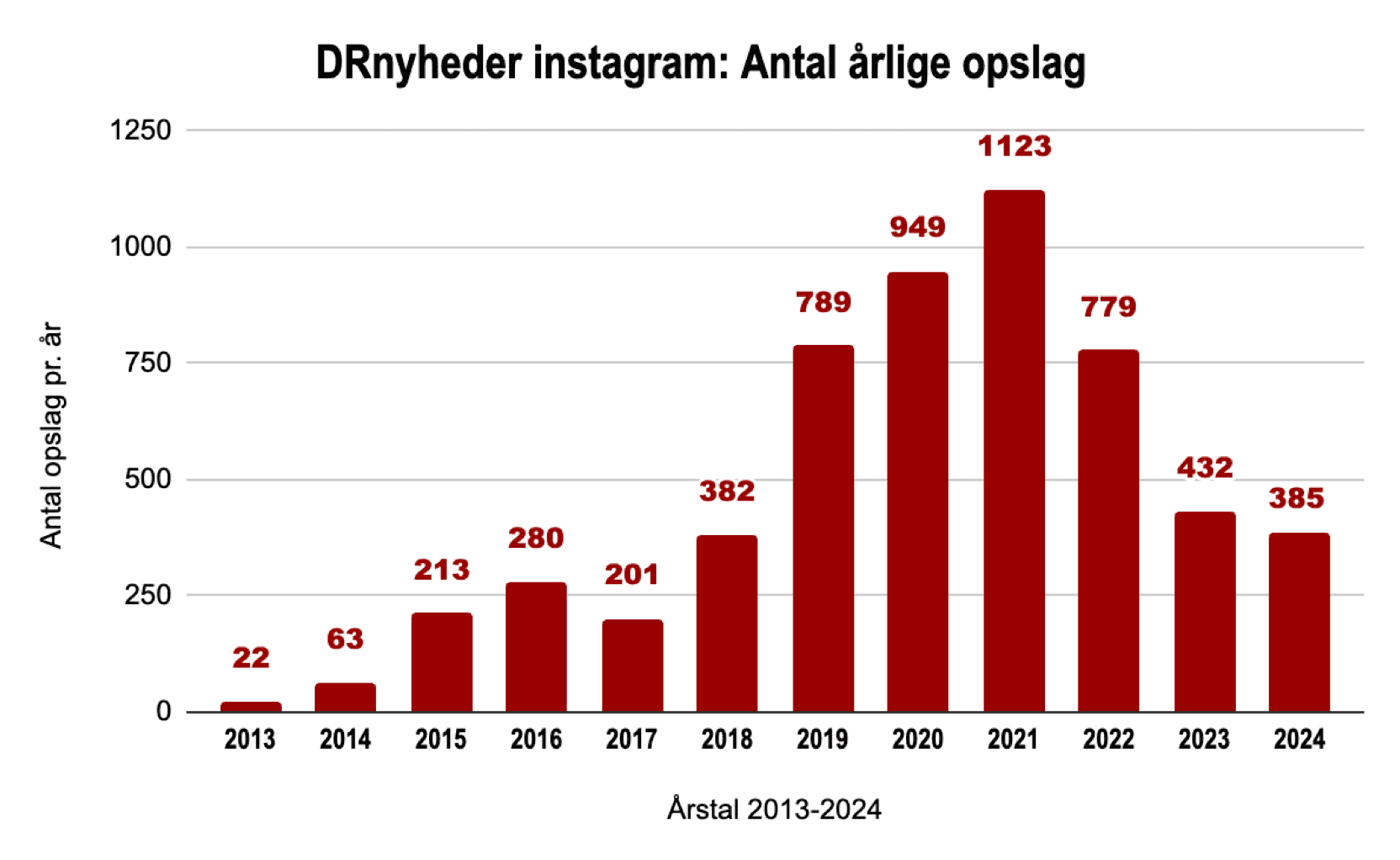
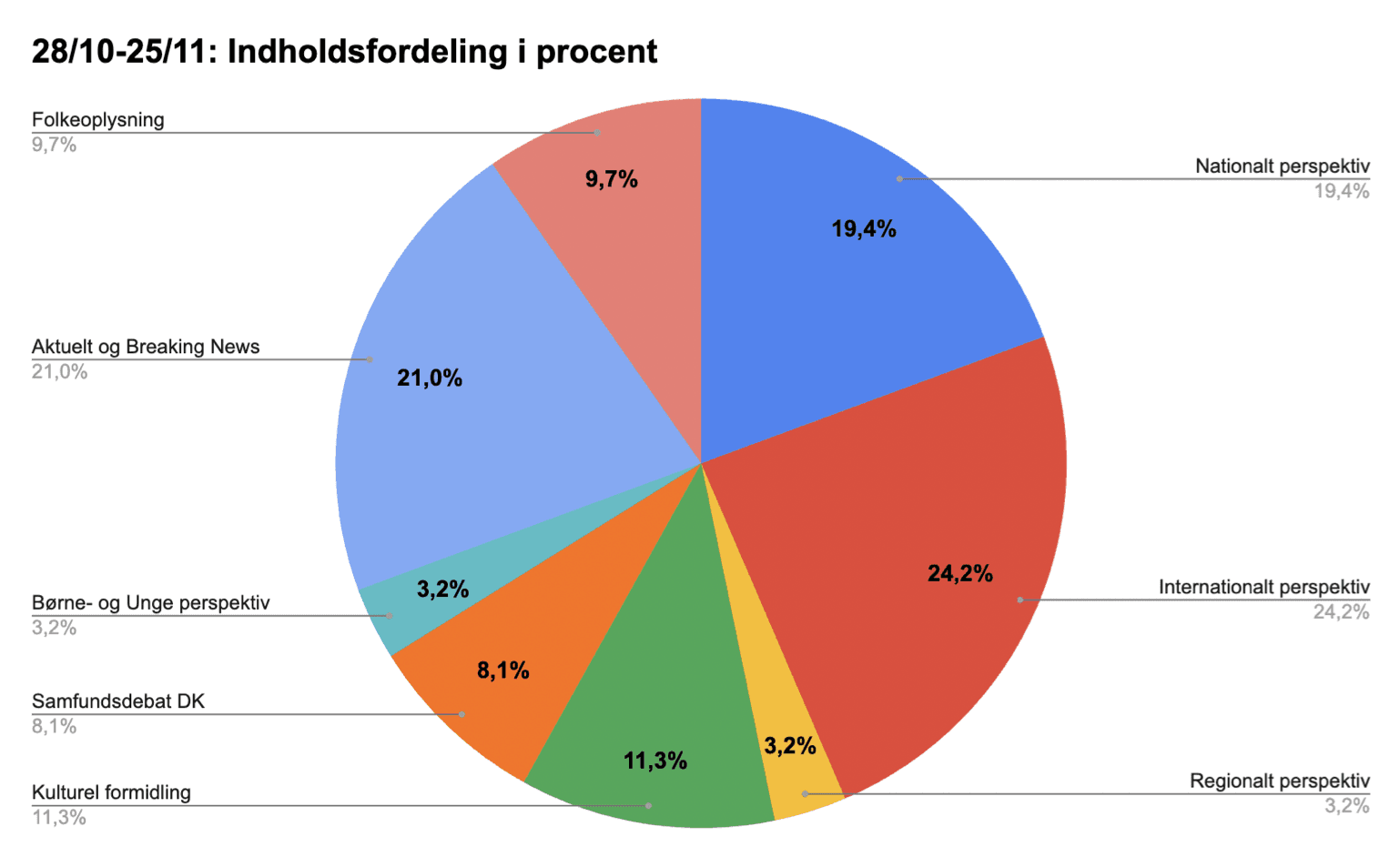
Posting grew from a handful of posts a year to a peak of 1,123 in 2021, then fell by around 30% the year after, as DR turned its focus back to dr.dk and its own apps (DR, 2022). Looking closer at a month of posts in 2024, three patterns stood out:
- Simple and visual. Every post is built for a quick swipe: one photo, one big headline and a short caption.
- Broad over niche. International and breaking news made up 45% of the content, while regional news and news for children and young people got only 3.2% each.
- Marketing, not distribution. 71% of the posts sent readers on to DR’s own platforms, using Instagram as a signpost rather than a home for the news (Sehl et al., 2018).
Discussion and conclusion
Being on Instagram lets DR reach young people where they are, as its public service contract requires (Kulturministeriet, 2023). But every post also adds value to a commercial platform, and its algorithms decide which news gets seen (Dijck et al., 2018).
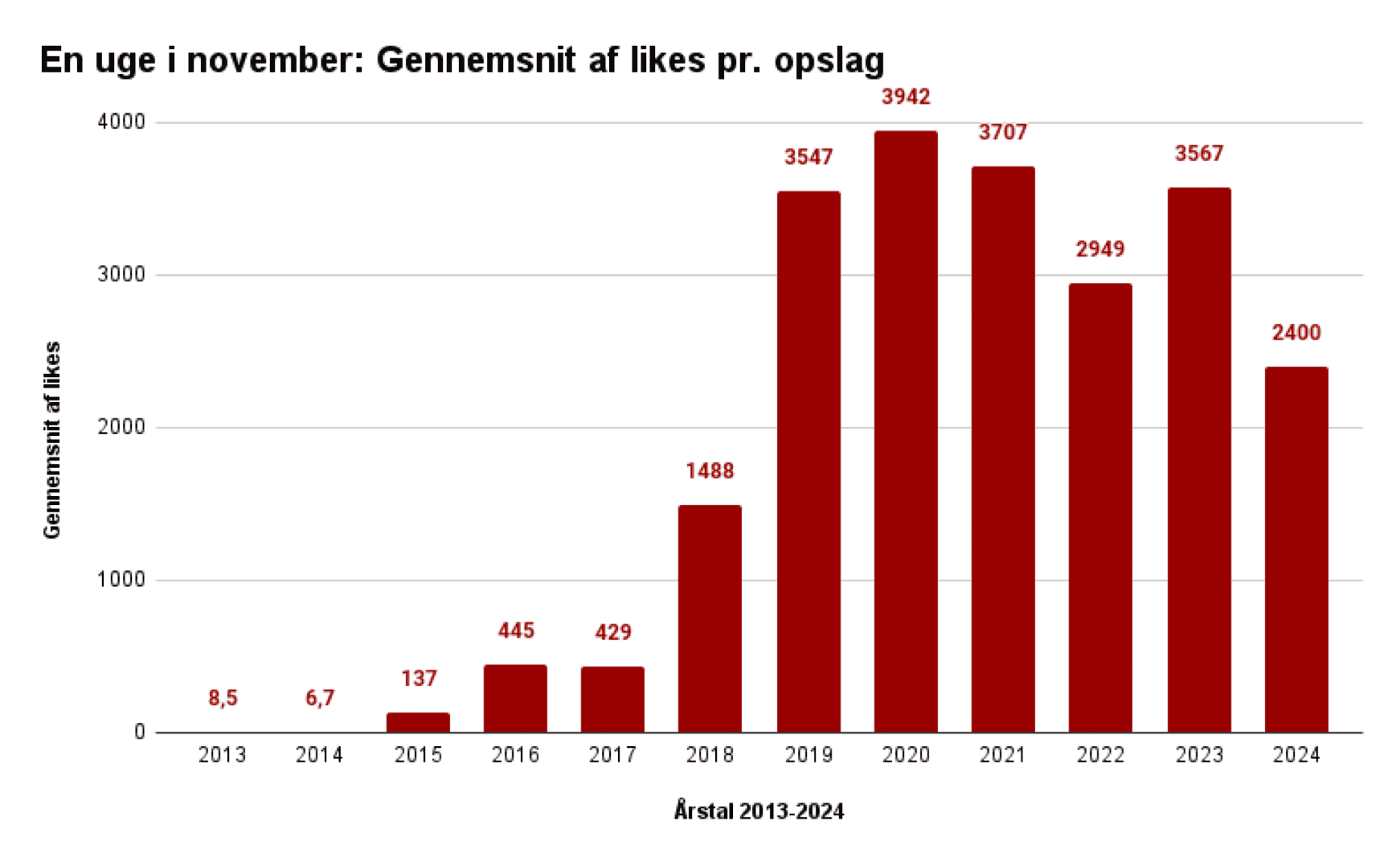
We concluded that DR’s presence is a balancing act rather than a dependency. With 343,000 followers, @drnyheder still reaches far after cutting back, and in today’s media system, leaving Instagram would be as much of a problem as staying.
How I use this in practice
From the thesis I bring a way of reading content strategically: counting and coding what an organisation actually publishes, and holding it up against what it says it wants to achieve.
At work, I can use that to audit a company’s social media, spot the gaps between strategy and output, and suggest content that fits both the platform and the brand’s purpose, while keeping in mind the trade-off of building on platforms you don’t own.
References
- Clark, T., Foster, L., Sloan, L., & Bryman, A. (2021). Bryman's social research methods (6th ed.). Oxford University Press.
- Dijck, J. van, Poell, T., & de Waal, M. (2018). The Platform Society. Oxford University Press.
- DR. (2022). DR Nyheder er parat til at tabe “masser af trafik” på at lukke for kommentarer på Facebook. Retrieved 12 December 2024 from https://journalisten.dk/dr-nyheder-er-parat-til-at-tabe-masser-af-trafik-paa-at-lukke-for-kommentarer-paa-facebook/
- Kulturministeriet. (2023). DR's public service-kontrakt for 2024–2026. Retrieved 28 October 2024 from https://kum.dk/fileadmin/_kum/2_Kulturomraader/Medier/DR/Public_service-kontrakt_for_DR_2024-2026.pdf
- Moe, H. (2024). Embrace or leave social media? On the viability of public service media organizations' strategies facing platform power. European Journal of Communication, 1–13.
- Sehl, A., Cornia, A., & Nielsen, R. K. (2018). Public Service News and Social Media. Reuters Institute for the Study of Journalism, University of Oxford.