2025 | UX · App concept
Eventful: a UX project at Aarhus University
Design concept
There’s always something happening in Aarhus, but finding it means checking Instagram, websites, posters on the street and what friends happen to mention.
Together with a fellow student, I saw a chance to gather it all in one place, and to make deciding what to do feel less like searching and more like play.
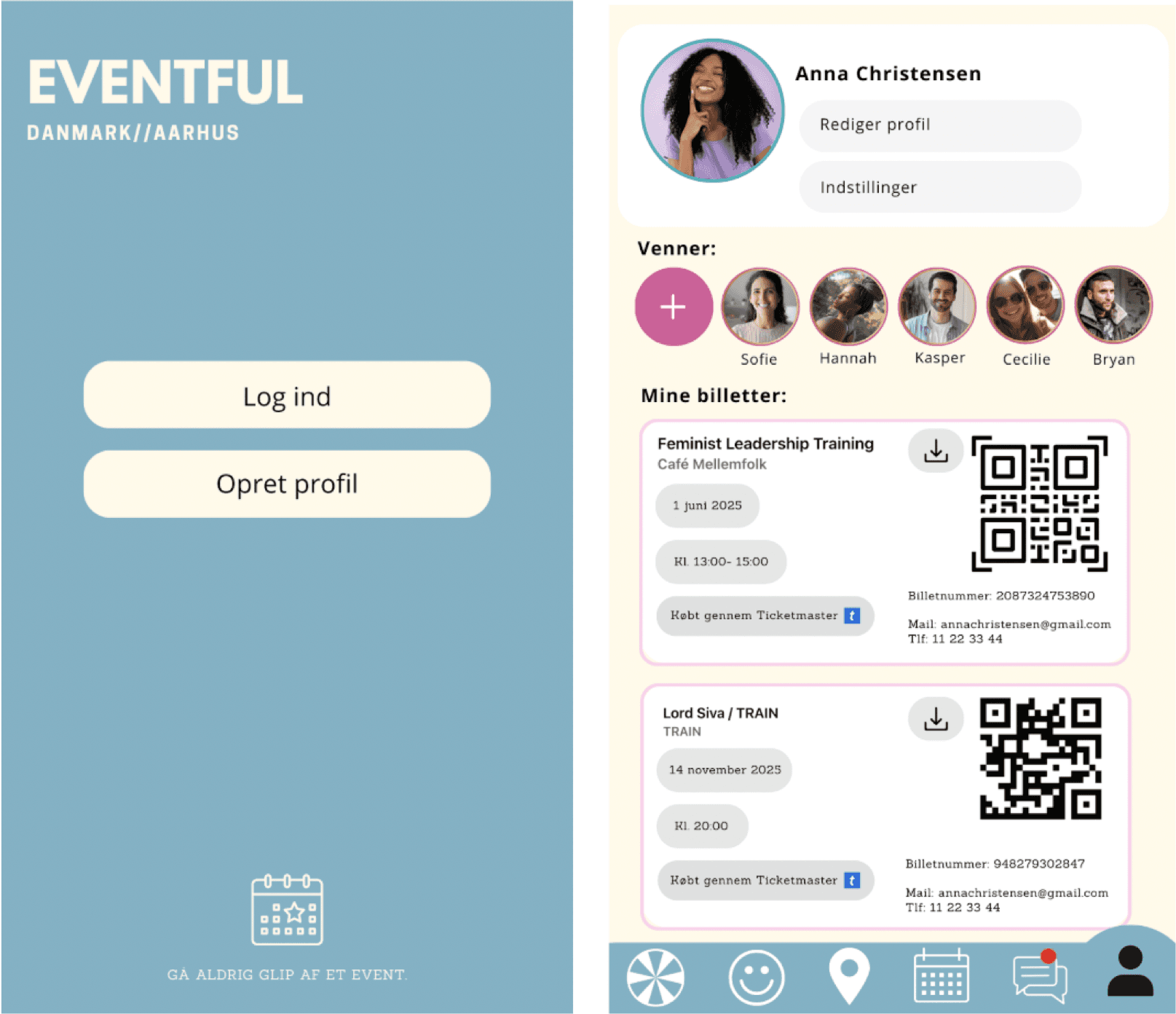
We ended up designing Eventful, an app that collects the city’s events and lets you filter them by budget, time, place and interests. Can’t decide? Tell it what mood you’re in, or spin the wheel for a random plan.
Research and first prototype
Our starting hypothesis was that people in Aarhus lack one place for events and would use it if it existed. To test it, we followed the design thinking process from interviews to tested prototype (IDEO.org, n.d.).
Semi-structured interviews (Tracy, 2025) quickly overturned our first assumption: hardly anyone found events on Facebook. People used Instagram and word of mouth, and the shared frustration was having to check too many places.
We turned the interviews into three personas and a set of jobs-to-be-done (Laubheimer, 2017), and built a low-fidelity prototype in Canva (Lim, Stolterman & Tenenberg, 2008) with five features:
- A map of events around the city
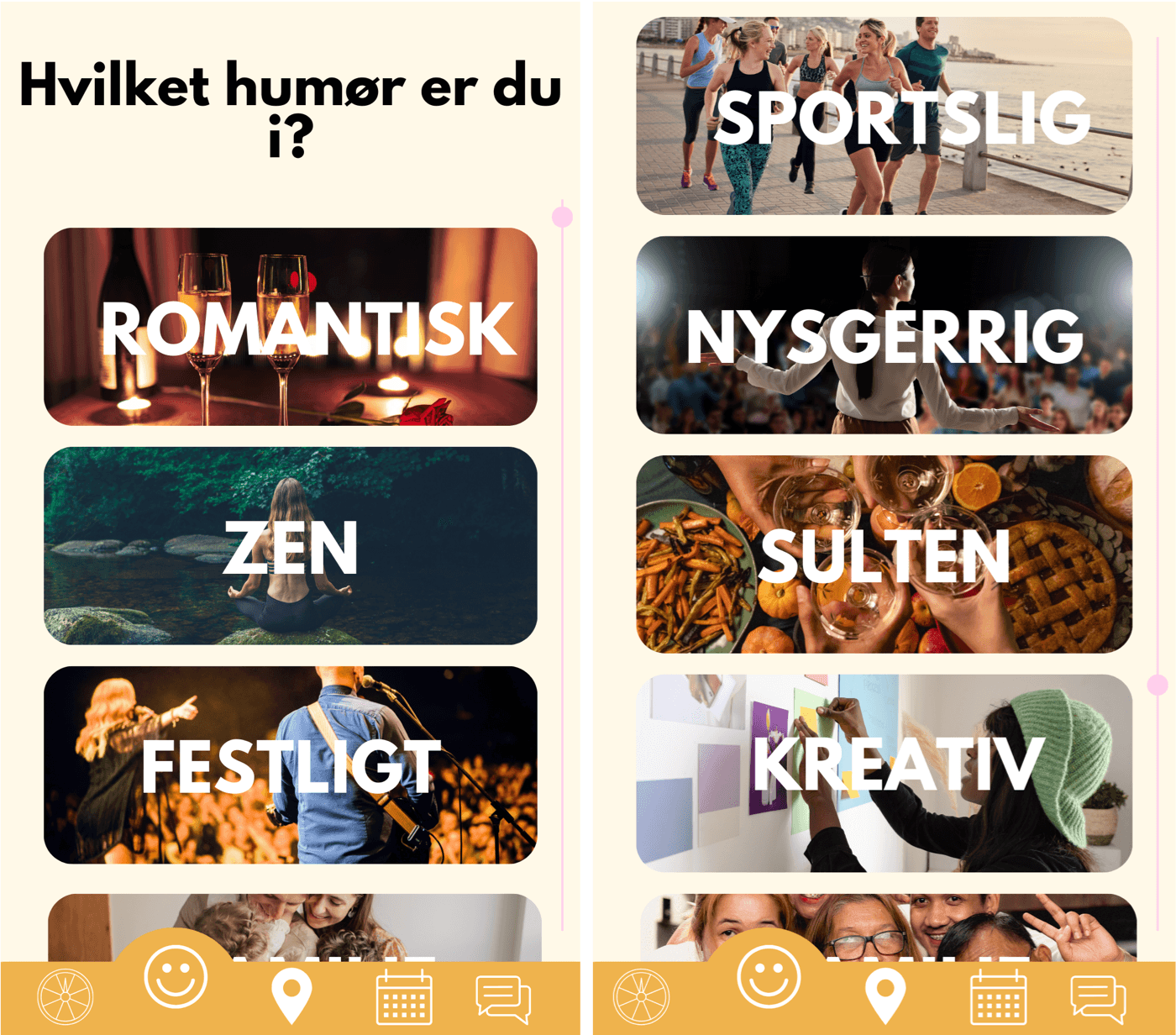
- “What mood are you in?”, which suggests events to match your mood
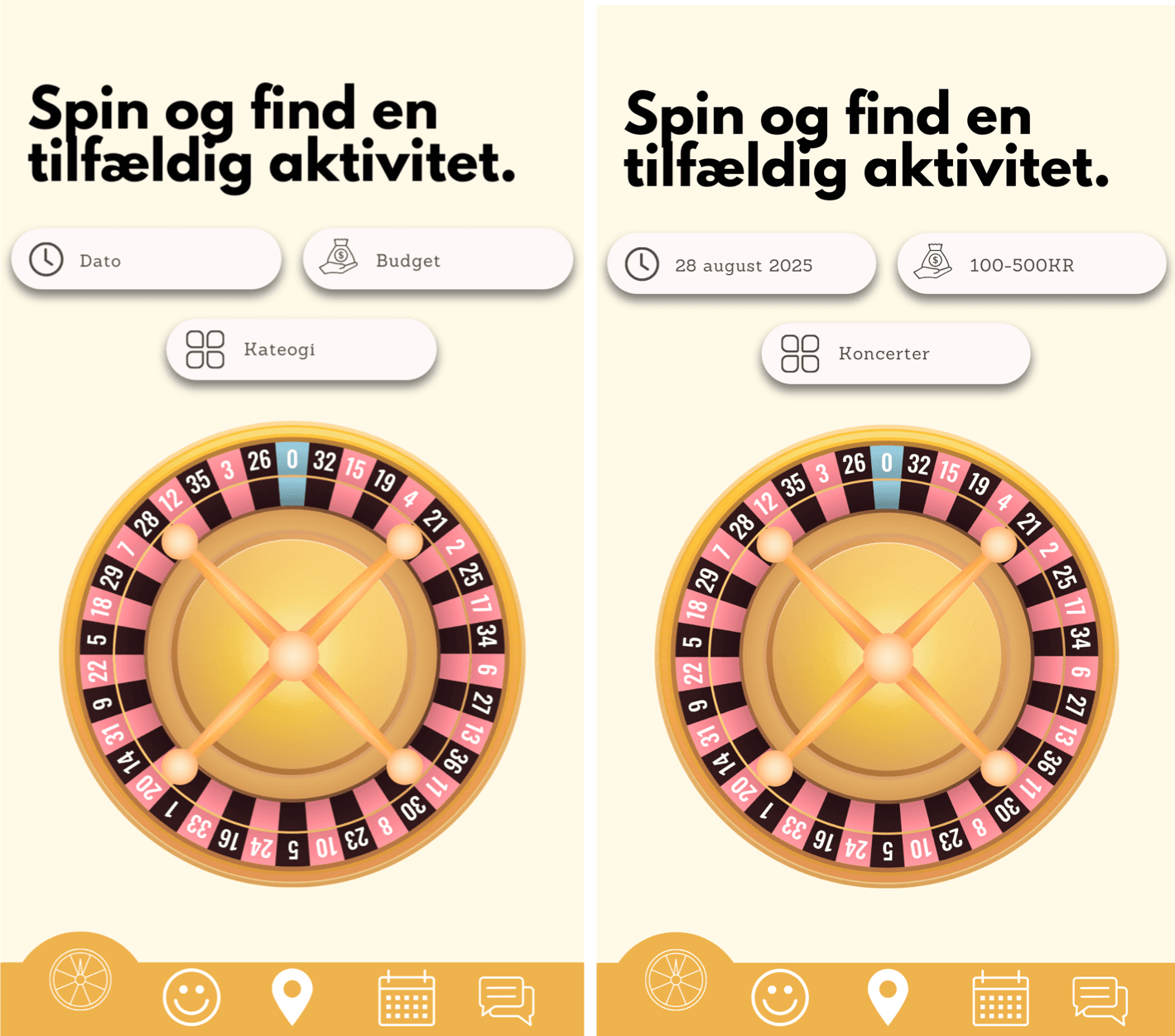
- “Spin and find”, a wheel that picks a random activity
- A calendar and search with filters
- A chat for planning with friends
Testing and second iteration
In user tests, the mood feature and the wheel were the favourites, while the map wasn’t intuitive enough and some icons were unclear. In the second iteration we added a login and profile, made the navigation clearer, and split the calendar into saved and recommended events.
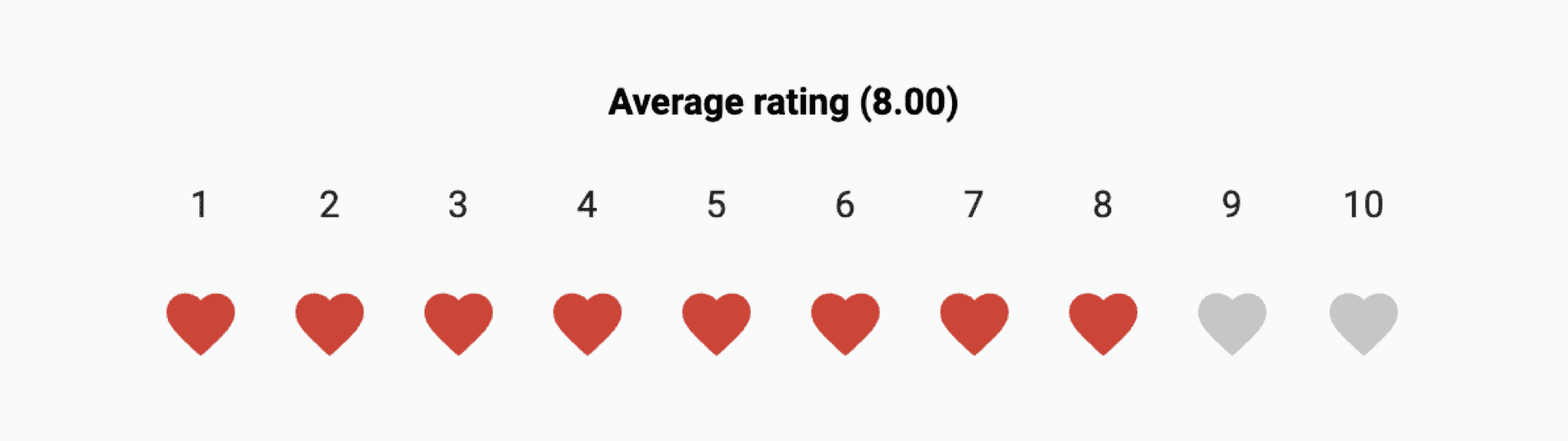
In a follow-up survey, 75% found the app more intuitive than before, and every tester found the icons and the mood feature clearer. Asked how likely they were to use it, they gave Eventful 8 out of 10 on average. With a small group of testers, there is still work to do before it’s a 10.
Learnings
Looking back, the strength of the project was how closely we involved the users. By testing, listening and daring to go back when something didn’t work, we ended up with a prototype that fits their needs far better than our first idea.
The weak spot was settling on an app too early. Jumping straight from the problem to a product may have shut out simpler solutions, so next time I would give the define and ideate phases more room to explore. And before Eventful could go live, it would need testing on a much larger group.
How I use this in practice
Eventful gave me hands-on experience of the whole design process, from interviews and personas to prototypes, user tests and a second iteration.
At work, it means I can take a vague idea, test the assumptions behind it early, and let users’ feedback shape the product rather than my own preferences. And I know to keep the early phases open long enough that the solution isn’t decided before the problem is understood.
References
- IDEO.org. (n.d.). Human-centered design: Design kit. Retrieved 19 February 2025 from https://www.designkit.org/
- Laubheimer, P. (2017, 6 August). Personas vs. Jobs-to-Be-Done. Nielsen Norman Group.
- Lim, Y. K., Stolterman, E., & Tenenberg, J. (2008). The anatomy of prototypes: Prototypes as filters, prototypes as manifestations of design ideas. ACM Transactions on Computer-Human Interaction (TOCHI), 15(2), 1–27.
- Tracy, S. J. (2025). Qualitative research methods: Collecting evidence, crafting analysis, communicating impacts (3rd ed.). Wiley-Blackwell.